For newcomers

At the bottom of each post there is the word "comments". If you click on it you will see comments made by followers, and if you follow the instructions you may also comment and I always welcome that. I have found many people overlook this part of the blog which is often more interesting than the original post!

My blog nick-name is SIR HUGH. I'm not from the aristocracy - my middle name is Hugh which relates to the list of 282 hills in Scotland compiled by Sir Hugh Munro in 1891. I climbed my last one (Sgurr Mor) on 28th June 2009

****************************

Showing posts with label climbing. Show all posts

Friday, 9 January 2015

The spirit stirred

As a youth I was a modest, but regular rock climber until I was married at the age of thirty. Later, around the age of fifty four I met  Pete (not Thursday Pete) and climbed with him for three years until he went his own way after I baulked at his over ambitious attempts to lead climbs graded beyond what I considered his ability. I then met Tony and climbed with him for seven years until he sadly died quite suddenly from cancer in 2003 - Tony was a great friend and we had many other interests in common, and I shall always miss him. I had no desire to continue climbing after he went.

Having said all that I can't pass a lump of rock without a stirring inside compelling me to assess it for potential lines and having a good look to see if there are chalk marks indicating climbing activity.

My Thursday walk with Pete this week took us close to Whitestones Crag (SD 387 849), a minor venue seen from the High Newton by-pass on the way to Newby Bridge.

Whitestones is geographically ambiguous and has ended up in the Lancashire Rock guide rather than one of the Fell and Rock Lake District guides and that may be why I don't often spot people climbing there. But there is another connection here. Tony was as an accomplished, and rock solid leader up to at least E1 grade and I would have followed him anywhere, but our sole visit to Whitestones resulted in the only occasion that Tony fell whilst I was with him. It was not serious - he was only a few feet off the ground starting the first pitch and the rope was of no help and he unfortunately decked with more of an affront to his dignity than injury. Tony was not pleased.

Our Thursday walk this week took us on pleasant lanes around High Newton with distant views of Whitestones stirring these old memories.

The arrow indicates Whitestones Crag two and a half kilometres away

Incredible zoom to Whitestones taken from the location of the photo above. This was hand held - very difficult to  keep still enough to frame the crag, but a tribute to the Panasonic TZ40 camera.

Yet another take on Lake District dry stone walling techniques

Wednesday, 13 March 2013

Cracoe Fell and Sharp Haw (two Marilyns north of Skipton)

Tuesday 12th March 2013

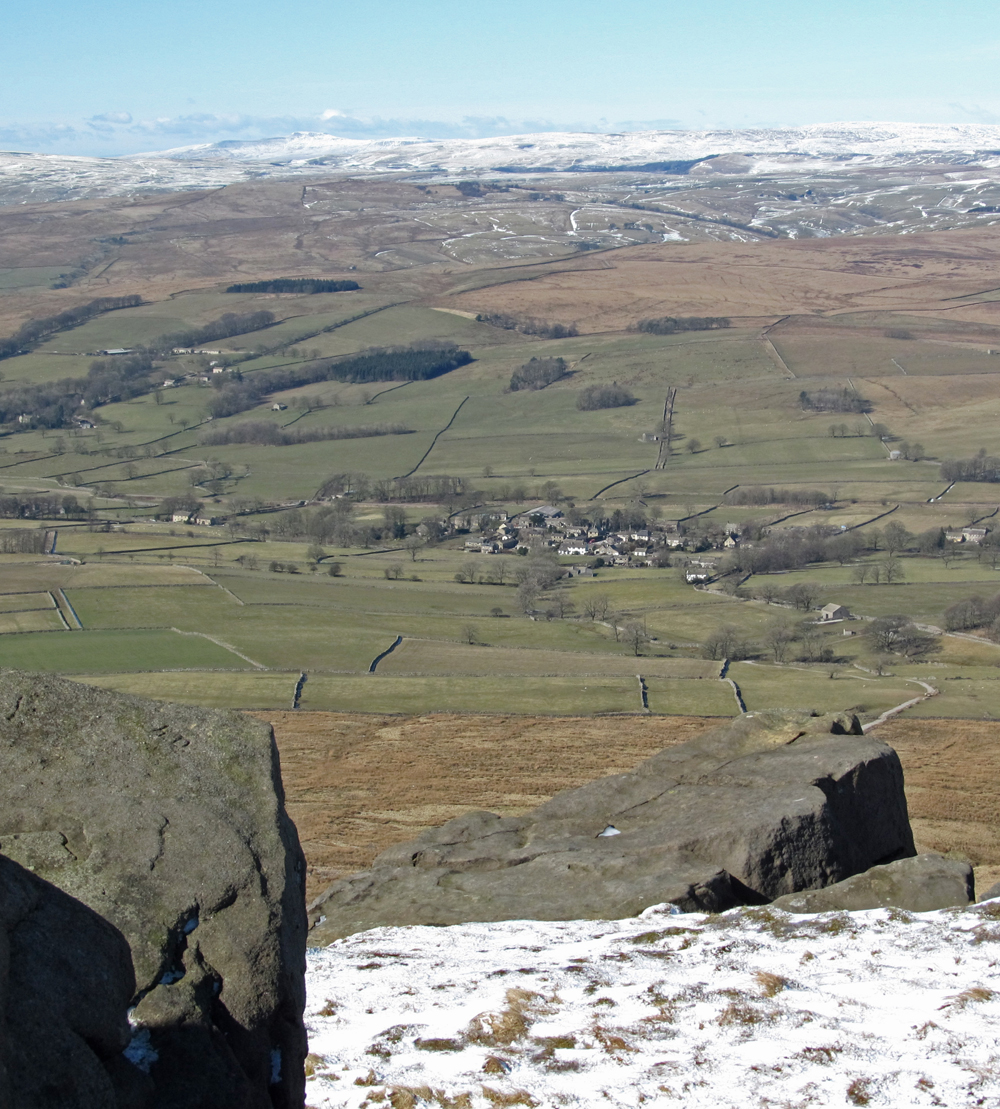
Rylstone Crag and Rylstone Cross lead north along the ridge to the war memorial obelisk on Cracoe Fell.

I have climbed often at Rylstone Crag. My last visit (13th Sept. 1992) was not joyous.

Tony, Rod and Pete had decided to set off at 12:30 from Preston. I was unhappy about the late start, so drove from Preston at 7:20 am to Whitbarrow (south Cumbria), did my one hour run and returned to Preston in time to meet up with the team at 12:30.

The rest of the day was a mess:

"Pete and I did Castrol VS. Pete took a long time leading it, and I got very cold. I had a desperate time on this climb, the worst since my return to climbing. We must have been two hours on this 30 ft. climb! My heart is not really in this gritstone stuff, but this has been the wettest August and September this century, and we haven't been able to get up to The Lakes. After Castrol we did Dental Slab. S., an old favourite which I led twenty years ago.

All that way for two gritstone climbs!"

The anti-gritstone statement was a knee-jerk reaction, and does not reflect my normal favourable opinion.

Today I looked down Dental Slab from the top and was close on a bilious attack.

A five minute drive down the road took me to the start for Sharp Haw, and I was up and down within an hour. This is a true mini mountain with a sharp peak and extensive panoramic views. A chap from Skipton caught me up on the descent and we chatted - he knew Brian Murphy, an acquaintance from attending Yorkshire Mountaineering Club Easter meets with Malcolm Lomas a few years ago.

A good day on the hills, and a  welcome contrast to my 1992 visit.

Click to enlarge. 

From the car. Rylstone Cross is top of nearest hill, Cracoe Fell far skyline


Cracoe Fell obelisk war memorial just visible on skyline


Crookrise Crag, zoom from start for Sharp Haw. This was another frequently visited crag in my climbing days

Down to Cracoe and my return route from Cracoe Fell

This track became a path just after the extent of this pic. Sharp Haw, my mini mountain is the obvious peak.

C'est moi

Zoom to Rylstone Cross and Cracoe Fell. The cross is on the hill in the foreground


Sunday, 26 June 2011

Dickie Morsley - update on my post of 6th May (day 17 of Welsh Walk)

In the post referred to I told of meeting the widow of Dickie Morsley in Llandygai near Bangor. Mrs M told me of her husband’s connections with JHB Bell who I erroneously said had written “Mountaineering in Scotland”, the proper title of his classic opus is “A Progress in Mountaineering” published in 1950. John Proud and Tom W did some research and found some reference to Dickie, and these are detailed in the comments on the post.
In Bell’s book I have found reference to Dickie in a lively account by Bell of an ascent of Central Buttress on Scafell in September 1940 with Dickie,  Jack Henson and Percy Small. Here is a short extract describing the start.
“The climb started up a steep slab with with two rather difficult movements. At the top of the first pitch we were hailed by Syd Cross, and Mrs Cross and A T Hargreaves from below, bestowing words of advice and encouragement. Cross had led CB in boots without any combined tactics at the Flake Crack ...”
Mrs M also mentioned her husband making the first ascent of Suicide Wall which led me to The Climbers’ Club Guide to Ogwen and Carneddau (1993), and the following extract.


 "Of the characters hardened by army training Chris Preston stood out above the rest. He had been one of the party which clipped an hour off the Welsh 3000 footers, and after a day's climbing had raced up Snowdon in 48 mins. His route Advocate's Wall on the Devil's Kitchen was merely a prelude to a major breakthrough. On October 7th 1945 Preston led the first route on Suicide (WallSuicide Wall Route 1). By modern standards it is graded E2 5c, and one must remember that it was done in gym shoes - there were no runners - and it was utterly serious and committing from the moment that he made his big push. Not surprisingly there were only two repeats during the next 14 years, and the route remained for some years as the hardest route in the country. By comparison John Lawton's  1948 route Suicide Groove was far more amenable, but nevertheless it was an intimidating line and compared well with other hard routes of the day.


One pre-war push had been made when Paul Work and APG HUghes attacked the front to Llech Ddu but sadly after completing three very hard pitches they were forced to retreat. It was left to George Dwyer and Dickie Morsley to complete the Central Route of Llech Ddu in 1946. It was an inspired foretaste of what was to come in the future".


I have not been able to trace who seconded Preston on Suicide Wall, but guess this may have been our Dickie - I reckon persistent Googling may find the answer, but Climbers’ Club records are unreadable on badly reproduced pdfs. Somebody who is a member would presumably have access to the originals, which would also most ilkely be lodged with the British Library.